The same ERP issues appear in different systems.
ERP pressure is not limited to one vendor. It appears in legacy systems, modern cloud platforms, hybrid environments, heavily customized landscapes, and companies operating across multiple entities or regions.

“We were promised efficiency, but now basic changes require outside help.”

“ERP was supposed to reduce spreadsheets, but the spreadsheets became the safety net.”

“The system is technically running, but nobody can explain the full process anymore.”
When spreadsheets become the real ERP, the system is no longer serving the business.
Many companies did not fail their ERP system. The ERP system failed to reflect how the business actually operates. When Excel becomes the safety net for planning, reporting, approvals, reconciliations, inventory, customer data, or executive visibility, the issue is not user resistance. It is a signal that the company needs to regain authority over its process, data, reporting, and roadmap.
The real issue is misalignment.
ERP decisions are often shaped around vendor models, implementation templates, licensing structures, and technical assumptions before the company’s operating reality is fully understood.
Business first
The system should reflect how the company serves customers, manages operations, controls data, and makes decisions.
Technology agnostic
The right answer may involve fixing, integrating, simplifying, replacing, or governing the existing landscape — not forcing one vendor model.
Customer control
The company should understand its own processes, data logic, integrations, reports, and roadmap without becoming fully dependent on external parties.
Problems that appear when ERP implementation is led by the technology instead of the business.
These situations create concern for owners, executives, managers, finance teams, IT leaders, and users. They are not signs that the customer is wrong. They are signs that the ERP conversation needs to be reframed around business requirements, capabilities, accountability, and strategic direction.
The business adapts to the system
Teams change how they work to satisfy the software, even when the process becomes slower, less intuitive, or less transparent.
The vendor owns the answers
The company cannot explain its own workflows, reports, integrations, or data logic without support tickets, consultants, or specialized vendor knowledge.
Reports become negotiations
Different teams produce different versions of the truth, and leadership has to reconcile numbers manually before decisions can be made.
Workarounds become the real system
Spreadsheets, email approvals, side databases, manual exports, and local fixes become necessary to keep the business moving.
Add-ons become permanent dependencies
Each missing capability gets patched with another extension, creating a landscape that is harder to support, upgrade, secure, and govern.
Integrations become fragile
The business depends on connections between ERP, CRM, eCommerce, warehouse, EDI, finance, and reporting tools that are difficult to monitor or change.
Projects drift away from business value
The ERP initiative continues, but the original business purpose becomes unclear, ownership weakens, and leadership loses confidence.
The customer loses authority
The company becomes dependent on external vendors, consultants, or platforms to understand and change its own operating model.
ERP problems multiply across international, multi-entity, and holding-company environments.
Many ERP issues are manageable in one company, one country, or one system. But the effect becomes exponential when the business operates through holding companies, subsidiaries, regional teams, shared services, legacy platforms, local requirements, and cross-border reporting needs. This is where experienced ERP oversight becomes critical: someone must connect the business requirements, system capabilities, data logic, integrations, reporting expectations, and project execution plan.
Holding-company structures
Multiple subsidiaries, operating companies, reporting expectations, ownership models, and consolidation needs.
Cross-border operations
Teams, vendors, customers, and systems spread across the United States, Central America, the Caribbean, Europe, the Middle East, and other markets.
Regional ERP differences
Local processes, compliance expectations, integration needs, and data definitions that do not always align.
ERP oversight service
Experienced guidance to align requirements, capabilities, project governance, reporting, and vendor execution across the landscape.
Obsolete systems, under-maintained platforms, and the messy middle.
ERP risk increases when companies stop maintaining older systems because they are viewed as obsolete, too customized, too expensive to change, or too risky to touch. Over time, inaccurate reporting, surprise downtimes, aging integrations, security exposure, unsupported customizations, and limited internal knowledge create a business problem that is larger than the software itself.
Microsoft ERP environments
Legacy Microsoft ERP environments can remain mission-critical long after the organization has stopped investing in modernization, documentation, and support planning.
SAP ERP environments
SAP landscapes become more complex when core ERP, custom reports, add-ons, integrations, and migration pressure all need to be understood at the same time.
Mixed and integrated landscapes
The greatest risk often appears between systems, where ownership is unclear and data moves through fragile, undocumented, or manually supported processes.
Start with the operating reality, not the vendor template.
A serious ERP conversation should separate software limits from process design, data ownership, integration logic, governance, and execution discipline. This is how companies regain control before making the next technology decision.
Process
How work actually happens, including exceptions, approvals, handoffs, and workarounds.
Data
What the business relies on for reporting, accountability, planning, and decisions.
Integration
How ERP exchanges information with eCommerce, CRM, EDI, warehouse, finance, reporting, and external systems.
Governance
Who owns changes, standards, exceptions, priorities, system decisions, and future roadmap choices.
Execution
How the project, recovery plan, or digital transformation initiative is managed to completion.
Free the project from technology-led execution and lead with business requirements.
Before the next ERP decision, companies need a recovery framework that connects business requirements, system capabilities, strategic direction, data ownership, integration priorities, and professional project management. The objective is not to reject technology. The objective is to make technology serve the business plan.
Stabilize
Identify urgent operational risks, blocked users, inaccurate reporting, downtime exposure, critical system issues, and immediate business impacts.
Clarify Requirements
Define what the business actually needs across process, data, reporting, controls, integrations, roles, and performance.
Map Capabilities
Compare business requirements to current ERP capabilities, available extensions, integration options, and realistic modernization paths.
Align Strategy
Prioritize fixes and decisions based on operational value, risk reduction, strategic direction, project readiness, and executive ownership.
Govern Execution
Create an ownership model, roadmap, decision cadence, and project discipline to prevent the same issues from returning.
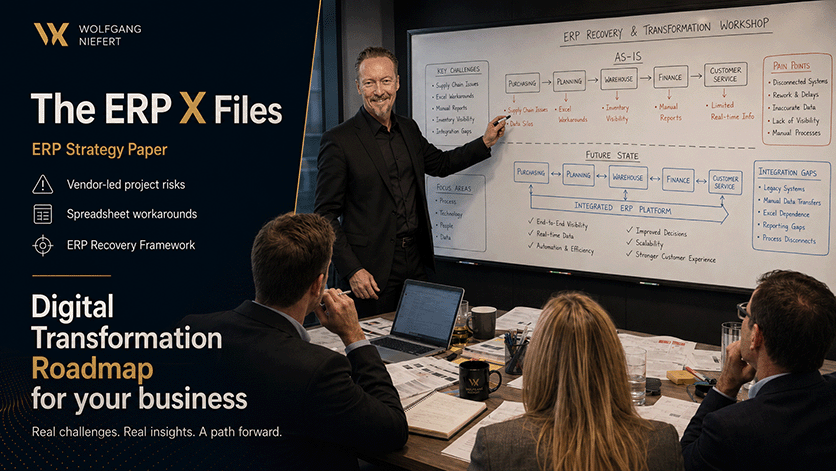
Do not make the next ERP decision in the dark.
Before buying another module, starting another migration, hiring another consultant, or replacing a system, step back and understand what is actually creating the risk. The ERP X Files strategy paper gives leaders a structured way to organize the problem before the next decision is made.